Distinctive Types of Abrasive Belts
Distinctive Types of Abrasive Belts
Abrasive belts are versatile and essential tools in industrial manufacturing, woodworking, metalworking, automotive refinishing, and numerous DIY projects.
The most fundamental classification of abrasive belts is based on abrasive material, as the grains directly determine the belt’s cutting ability and compatibility with different workpieces. The four primary abrasive materials used in belts are aluminum oxide, silicon carbide, zirconia alumina, and ceramic alumina, each with distinct characteristics.
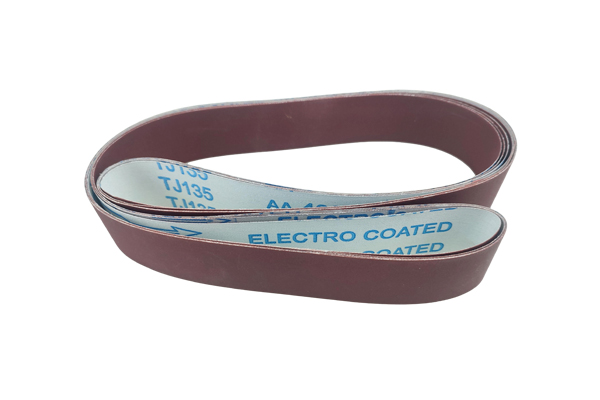
Aluminum oxide abrasive belts are the most common and versatile type, widely used in both industrial and hobbyist settings. Made from fused aluminum oxide grains, these belts are known for their balanced combination of hardness, toughness, and affordability. They perform exceptionally well on ferrous metals (such as steel and iron), wood, and plastic. Aluminum oxide belts are available in a range of grit sizes, from coarse (40–80 grit) for heavy material removal to fine (240–400 grit) for smooth finishing. A notable advantage is their self-sharpening property: as the grains wear down, they fracture to expose new sharp edges, ensuring consistent performance over time. This makes them ideal for general-purpose sanding tasks where cost-effectiveness and versatility are priorities.
Silicon carbide abrasive belts are distinguished by their high hardness and ability to cut through non-ferrous materials and brittle surfaces. Unlike aluminum oxide, silicon carbide grains are harder but more brittle, making them suitable for sanding materials like aluminum, copper, brass, glass, stone, and ceramic. They are also effective for wet sanding applications, as the abrasive material maintains its sharpness when in contact with water. Silicon carbide belts are commonly used in automotive refinishing (for sanding body filler and paint), semiconductor manufacturing (for polishing silicon wafers), and glassworking. However, their brittleness limits their use on hard ferrous metals, as the grains tend to chip or fracture under high pressure.
Zirconia alumina abrasive belts are engineered for heavy-duty metalworking applications, offering exceptional toughness and durability. Created by fusing zirconia with alumina, these belts feature grains that are both hard and resistant to chipping, making them ideal for sanding high-tensile strength metals such as stainless steel, titanium, and alloy steel. Zirconia alumina belts excel in aggressive material removal tasks, such as deburring, weld cleaning, and shaping metal components. They also exhibit strong self-sharpening capabilities, and their performance improves slightly with heat buildup—an advantage in high-speed sanding operations. While more expensive than aluminum oxide, their long lifespan and efficiency make them cost-effective for industrial settings where productivity is critical.
Ceramic alumina abrasive belts represent the premium end of the market, designed for the most demanding applications. These belts use synthetic ceramic grains that are harder and more wear-resistant than any other abrasive material. Ceramic alumina grains have a unique microcrystalline structure that allows them to self-sharpen aggressively, maintaining sharp cutting edges even during prolonged sanding of the hardest materials. They are primarily used in industrial metalworking for sanding tool steel, carbide, and other high-hardness alloys. Ceramic alumina belts also offer excellent heat resistance, reducing the risk of workpiece damage due to overheating. Despite their higher cost, their exceptional durability and cutting efficiency make them the preferred choice for high-volume, precision manufacturing operations.
Beyond abrasive material, abrasive belts are also distinguished by their backing material, which provides structural support and determines the belt’s flexibility, strength, and compatibility with different sanding machines. The three main backing materials are paper, cloth, and film.
Paper-backed abrasive belts are lightweight and economical, suitable for light-duty sanding tasks such as wood finishing and paint removal. They are available in different weights (from A to F), with heavier weights offering greater durability. However, paper backing is prone to tearing and water damage, limiting its use in heavy-duty or wet sanding applications. Cloth-backed belts are more durable and flexible, making them ideal for heavy-duty sanding, contour sanding, and metalworking. The cloth (typically cotton or polyester) is resistant to tearing and can withstand high temperatures and pressure. Film-backed belts, made from polyester film, are the most durable and water-resistant option. They are used for precision sanding, wet sanding, and applications where edge retention is critical, such as automotive refinishing and semiconductor manufacturing.
Another distinctive characteristic of abrasive belts is their grit size, which ranges from coarse (16–80 grit) to medium (100–240 grit) to fine (320–1000 grit) and ultra-fine (1200 grit and above). Coarse grit belts are used for heavy material removal, such as shaping wood or removing rust from metal. Medium grit belts are suitable for surface preparation and smoothing, while fine and ultra-fine grit belts are used for final finishing and polishing to achieve a smooth, glossy surface.
News
Contact Us
Contact: JinKaiYan Abrasives
Phone: +86 13663827325
Tel: +86 13663827325
E-mail: cici8686@foxmail.com
Add: Weidu Industrial zone Xuchang City, Henan province China